
Tate McRae vs. Fashion Show: Which Moment Defined the Victoria’s Secret 2026 Return?
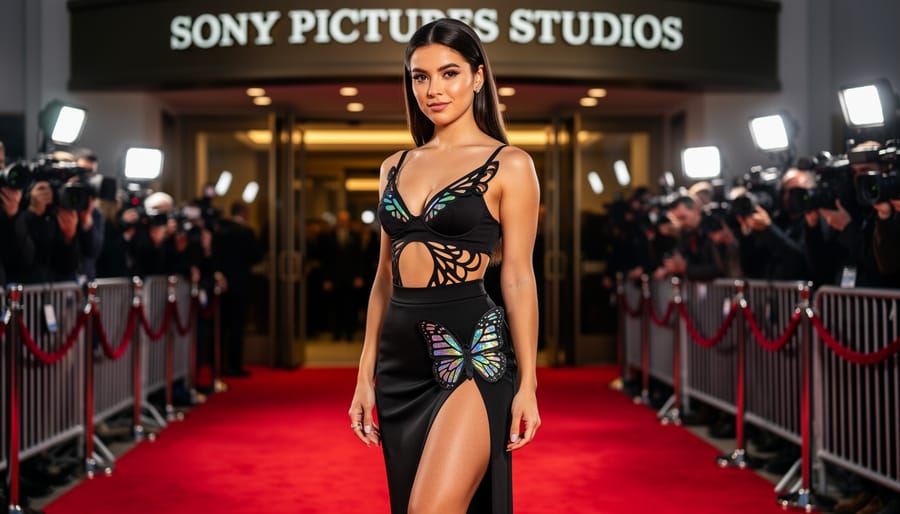
Tate McRae didn’t just attend the Victoria’s Secret Fashion Show 2026; she became its defining moment, proving that a custom Ludovic de Saint Sernin set with butterfly wing cutouts can command more attention than the runway itself. When she stepped onto the red carpet at Sony Pictures Studios in Culver City, California on October 18, the strategic placement of wing-shaped silhouettes across her black bra and matching skirt with a hip-high slit sparked instant viral curiosity about whether this was a celebrity appearance or a fashion statement that rivaled the event’s carefully curated spectacle.
The question framing this moment as “Tate McRae vs Fashion Show” captures exactly what happened: a single look so precisely executed that it competed with, rather than complemented, the show’s own narrative. Fashion enthusiasts and industry professionals immediately recognized the strategic brilliance of the butterfly motif, a design choice that nodded to Victoria’s Secret’s iconic wings while asserting complete independence from the brand’s aesthetic vocabulary. This wasn’t a collaboration or a coordinated moment. It was a masterclass in using a major platform to establish personal style authority.
What makes this comparison worth dissecting is the shift it represents in fashion hierarchy. Major events like those on the US Fashion Week list have traditionally dictated the terms of engagement, but McRae’s appearance illustrates how individual style moments can now eclipse the frameworks designed to showcase them. The viral response wasn’t about the Victoria’s Secret show; it was about her command of a custom piece that balanced provocation with precision, creating a cultural flash point that demands both context and expert analysis.
At-a-Glance: Red Carpet vs. Runway, The Dual Spectacle
The October 18, 2026 Victoria’s Secret Fashion Show at Sony Pictures Studios delivered not one but two distinct fashion spectacles, Tate McRae’s red carpet arrival and the main runway event. Here’s how these moments compared across the dimensions that matter most to fashion insiders and enthusiasts.
| Aspect | Red Carpet Moment | Main Show | Cultural Impact |
|---|---|---|---|
| Designer | Ludovic de Saint Sernin custom piece | Multiple Victoria’s Secret collaborations | Single designer vision won attention |
| Look Details | Black bra, butterfly wing cutout matching set, wing-shaped waistline, hip-high slit skirt | Traditional lingerie-focused runway looks | Architectural innovation outpaced classic approach |
| Timing | Pre-show red carpet arrival | Main event runway presentations | Red carpet set social media tone |
| Viral Reception | “Mesmerising angel” social media response | Collective show highlights | Individual moment dominated conversation |
| Fashion Significance | Celebrity-designer collaboration showcasing body-conscious architecture | Brand revival and heritage presentation | Redefined red carpet as primary fashion statement |
This breakdown reveals a fundamental shift in how major fashion events generate cultural currency. McRae’s custom Ludovic de Saint Sernin moment functioned as the evening’s defining image before the main show even began, demonstrating how red carpet arrivals now compete with, and often surpass, the runway presentations they precede.
What Each Option Is: Understanding the Two Fashion Moments
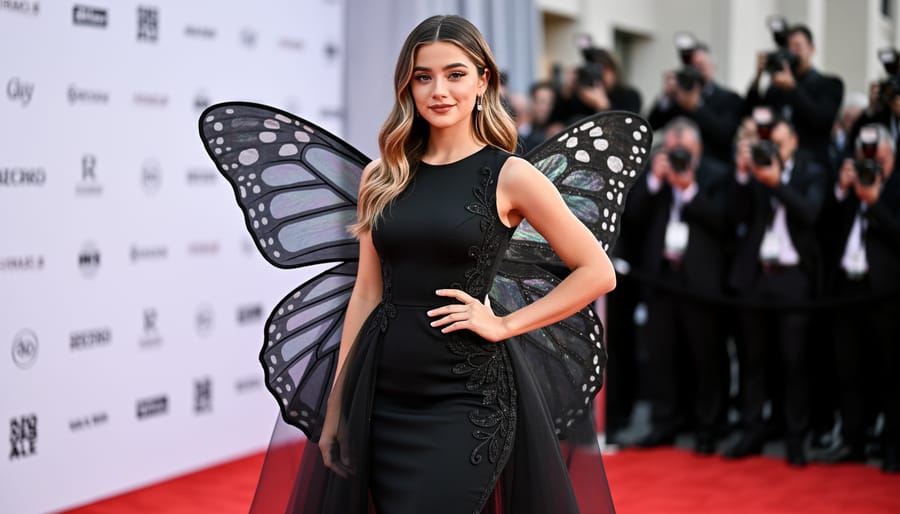
The Red Carpet Moment: Tate McRae’s Ludovic de Saint Sernin Masterpiece
On the evening of October 18, 2026, Tate McRae arrived at Sony Pictures Studios in Culver City, California, and immediately redefined what a red carpet entrance could accomplish. McRae’s Ludovic de Saint Sernin look for the Victoria’s Secret Fashion Show 2026 was not just an outfit but a calculated fashion statement that merged the designer’s architectural precision with the event’s iconic imagery.
The custom matching set centered on a deceptively simple foundation: a black bra paired with a high-waisted skirt. What elevated this beyond basic separates was Ludovic de Saint Sernin’s signature approach to negative space and body architecture. The butterfly wing cutouts framed McRae’s torso with laser-cut precision, creating visual movement that echoed the show’s angelic motifs without literal replication. The skirt’s wing-shaped waistline continued this theme, dipping and rising to mirror organic flight patterns, while a hip-high slit added both drama and ease of movement.
- Butterfly Wing Cutouts
- Laser-precise negative space carved into fabric to frame the body while creating the illusion of wings emerging from the garment itself. These cutouts transform fabric into sculpture, requiring exact pattern-making to maintain structural integrity.
- Wing-Shaped Waistline
- A skirt waistband engineered to rise and fall in an organic wave pattern mimicking butterfly wing edges. This technique demands advanced draping skills to balance visual drama with wearability.
- Strategic Placement
- The deliberate positioning of cutouts, seams, and embellishments to guide the eye and flatter specific body proportions. In custom work, this involves multiple fittings to achieve perfect alignment with the wearer’s form.
- Custom Set Construction
- Coordinated separates designed as a single aesthetic unit rather than mix-and-match pieces. The bra and skirt share proportional relationships, fabric treatments, and design language to read as one cohesive look.
The styling choices reinforced rather than competed with the design. McRae kept jewelry minimal and hair sleek, allowing the cutout architecture to command full attention. This restraint demonstrated sophisticated red carpet instinct: knowing when to let a single bold piece do all the talking, particularly when that piece carries this level of technical and conceptual ambition.
The Main Event: Victoria’s Secret Fashion Show 2026 at Sony Pictures Studios
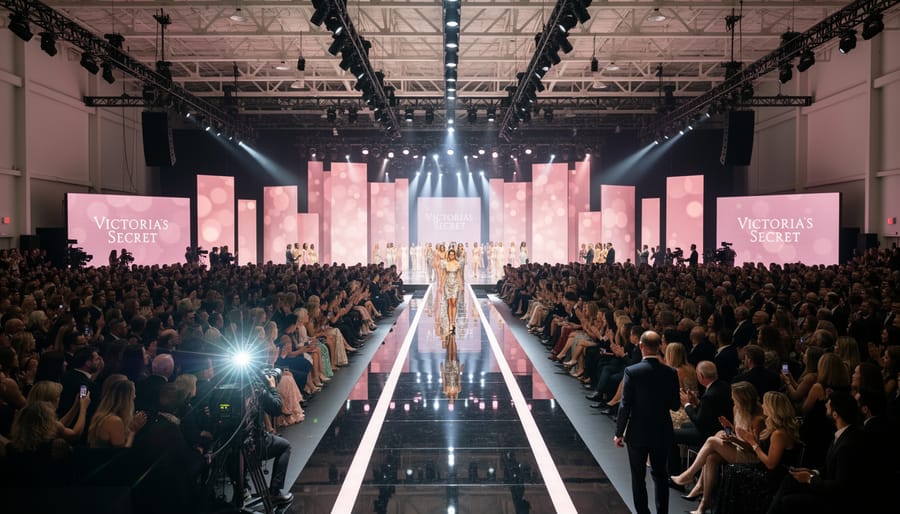
The Victoria’s Secret Fashion Show 2026 marked a significant return for the brand, held at Sony Pictures Studios in Culver City, California on October 18, 2026. The event brought together runway presentations, musical performances, and the brand’s signature angel aesthetic in a carefully choreographed evening that positioned itself as both fashion spectacle and entertainment production.
Tate McRae’s role extended beyond her red carpet arrival. She performed during the show itself, creating a dual presence that blurred the lines between musical guest and fashion participant. This integration reflected Victoria’s Secret’s strategy to merge celebrity performance with fashion presentation, transforming the traditional runway format into a multimedia experience where pop culture and fashion design converged on equal footing.
The Sony Pictures Studios venue provided a controlled environment for the production, allowing for elaborate set design and lighting that supported both runway segments and live performances. McRae’s involvement positioned her at the intersection of these elements, making her both performer and fashion subject within the broader event architecture.
The Look That Stopped the Internet: Breaking Down Every Detail
Ludovic de Saint Sernin: The Designer Behind the Viral Moment
Ludovic de Saint Sernin built his reputation on a singular vision: fashion that celebrates the body through architectural precision and unapologetic sensuality. The French designer, who launched his eponymous label after years at Balmain, has consistently pushed boundaries with designs that blur the line between second-skin intimacy and structural engineering. His aesthetic centers on revealing through concealing, strategic cutouts, bondage-inspired strapping, and body-conscious silhouettes that frame skin as part of the design itself rather than something to hide.
The custom piece he created for McRae’s red carpet moment exemplifies everything that defines his work. Those butterfly wing cutouts weren’t arbitrary embellishment; they’re classic de Saint Sernin, using negative space to create shape, transforming absence into presence. The wing-shaped waistline demonstrates his architectural approach, treating fabric as a medium for sculpture that moves with the body. Even the matching set format, pairing structured separates that read as a cohesive whole, reflects his signature construction method.
Within contemporary fashion, de Saint Sernin occupies a unique position. He’s embraced by both high fashion circles and celebrity stylists precisely because his pieces deliver editorial-worthy impact while remaining wearable. His designs appear regularly on red carpets and magazine covers, yet maintain credibility within the industry’s inner circles, a balance few designers achieve. This Victoria’s Secret moment reinforced his standing as the designer celebrities trust when they need to make a statement that’s bold without veering into costume territory.
Construction Meets Concept: How Butterfly Wings Became Fashion Gold

The butterfly wing cutouts weren’t decorative flourishes, they were load-bearing architecture. Ludovic de Saint Sernin engineered each cutout to follow the body’s natural movement lines, creating negative space that functioned as both structural element and visual punctuation. The wings emerged from the garment’s seams at precise stress points, distributing tension across the fabric so the piece could move without gapping or pulling. This technical precision meant McRae could walk, pose, and perform without the look losing its sculptural integrity.
The wing-shaped waistline operated as the look’s conceptual anchor, transforming a standard high-waisted skirt into something that read as metamorphosis in progress. Rather than simply sitting at the natural waist, the silhouette swooped and curved to mimic wing anatomy, with the hip-high slit extending the wing metaphor into motion. When McRae moved, the slit revealed glimpses of leg that echoed a butterfly’s emergence, controlled exposure that felt intentional rather than accidental.
What made this work as fashion rather than costume was the restraint. The black bra grounded the fantasy elements in contemporary lingerie-as-outerwear codes, while the matching set’s monochrome palette kept focus on form rather than colour. Saint Sernin understood that butterfly symbolism carries baggage, transformation, fragility, beauty standards, so he stripped it to pure geometry. The wings became about body-conscious tailoring and architectural ambition, not literal representation.
This convergence of construction technique, conceptual metaphor, and cultural timing created a look that photographed as both high fashion and instantly readable symbolism, the sweet spot for viral fashion moments.
Dimension-by-Dimension: How the Red Carpet Outshone the Runway
Design Innovation and Craftsmanship
McRae’s Ludovic de Saint Sernin piece represents a fundamental shift in how celebrity fashion show appearances challenge runway aesthetics. The custom set’s butterfly wing cutouts required precision pattern-making and structural engineering, each cutout positioned to create negative space that moves with the body rather than simply exposing skin. This level of architectural tailoring contrasts sharply with typical Victoria’s Secret show looks, which traditionally prioritize embellishment density and maximalist silhouettes over negative space manipulation.
The wing-shaped waistline demonstrates technical sophistication often absent from performance-focused runway pieces. Where show looks typically rely on predictable corsetry and strategic crystal placement, Saint Sernin’s design uses body contours as part of the garment’s architecture. The hip-high slit doesn’t merely add drama, it completes the butterfly motif through asymmetric movement potential.
This designer-driven vision differs from the collaborative, brand-led approach of main show looks. Saint Sernin maintained singular creative control, resulting in a cohesive concept from cutout placement to silhouette proportion. Most runway pieces balance multiple stakeholders, brand identity, performance requirements, lighting considerations, which often dilutes originality. The red carpet format freed this design from those constraints, allowing pure artistic merit to define its success.
Styling and Red Carpet Presence
McRae’s red carpet execution demonstrated meticulous attention to styling fundamentals that elevated the Ludovic de Saint Sernin piece beyond its architectural merits. She kept hair sleek and swept back, refusing to compete with the butterfly wing cutouts, a restraint that allowed the garment’s silhouette to command full attention. Minimal jewelry and natural makeup further emphasized this design-first approach, proving she understood the assignment wasn’t to layer accessories but to embody the look itself.
Her physical presence matched the styling discipline. McRae moved with confidence across the Sony Pictures Studios red carpet, adopting poses that showcased the wing-shaped waistline and hip-high slit from multiple angles while maintaining the poised elegance the moment demanded. She neither overworked the camera nor played safe, each angle revealed new details of the butterfly construction without descending into spectacle.
Measured against typical Victoria’s Secret runway styling, where models wear elaborate wings, heavy embellishment, and theatrical hair, McRae’s stripped-back approach felt refreshingly modern. Where in-show looks layer drama upon drama, her red carpet moment proved that strategic subtraction can generate equal or greater impact. The performance wardrobe inside the venue likely followed the brand’s maximalist tradition, but McRae’s entrance argued convincingly that sometimes the most powerful fashion statement is knowing exactly what to leave out.
Cultural Impact and Viral Reach
McRae’s red carpet arrival generated exponentially greater viral reach than the fashion show itself, illustrating a fundamental shift in how fashion moments circulate and resonate. Within hours of her October 18 appearance, the “mesmerising angel” look dominated fashion on TikTok and Instagram feeds, with close-up details of the butterfly wing cutouts accumulating millions of impressions before the runway presentation even concluded. The custom Ludovic de Saint Sernin set became its own conversation, dissected, recreated in fan edits, and analyzed by fashion commentators, while main show runway highlights struggled for comparable traction.
This disparity reveals how contemporary fashion consumption prioritizes distilled, shareable moments over sustained narrative. McRae’s look offered everything social algorithms reward: immediate visual impact, clear protagonist, architectural detail that photographs beautifully, and a celebrity figure whose existing fanbase amplifies reach beyond traditional fashion audiences. The red carpet moment became the event itself, eclipsing the runway it was meant to introduce and demonstrating that in 2026’s attention economy, a single perfectly executed arrival can outperform an entire production.
Who Should Choose Which: When to Watch Red Carpets vs. Main Shows
Your fashion consumption goals dictate which moments deserve your attention. If you’re building a portfolio for styling work or seeking immediate trend inspiration, red carpet arrivals like McRae’s Ludovic de Saint Sernin moment deliver the most actionable insights. These appearances showcase how designers adapt runway concepts for real-world impact, complete with styling nuances you can translate directly to client work or personal wardrobe planning.
When Red Carpet Moments Serve You Better:
- You track celebrity styling and real-time trend adoption rather than seasonal forecasting
- You’re a designer studying how custom pieces translate brand identity beyond runway constraints
- You follow biotech and beauty innovations and want to see how technical fabrics and sustainable materials appear in high-profile custom work
- Your social media strategy depends on viral fashion moments that spark immediate conversation
- You’re researching celebrity-designer collaborations and the creative process behind one-off pieces
Main runway presentations remain essential for trend forecasters and buyers tracking Fall 2026 trends across collections. The Victoria’s Secret show itself revealed directional themes in silhouette, fabrication, and color that inform retail six months out. If you’re analyzing brand positioning, merchandising strategies, or seasonal shifts, the full runway narrative provides context that isolated red carpet looks cannot.
Watch both when possible, but prioritize according to your immediate needs. Red carpets offer instant styling education and cultural conversation starters. Main shows deliver the comprehensive trend intelligence that shapes industry direction. The Tate McRae moment proves that sometimes the pre-show arrival generates more fashion value than the presentation itself, particularly when a custom piece captures the cultural zeitgeist this precisely.
What This Moment Means for Fashion Events and Celebrity Culture
Tate McRae’s October 18 red carpet appearance signals a fundamental shift in how fashion events generate cultural currency. While the Victoria’s Secret Fashion Show 2026 at Sony Pictures Studios delivered its expected runway spectacle, the custom Ludovic de Saint Sernin moment outside the venue commanded equal, if not greater, attention. This isn’t an isolated incident; it’s confirmation that red carpet arrivals now function as standalone fashion statements, separate from and sometimes eclipsing the main events they’re meant to precede.
For designers, this redistribution of attention creates both opportunity and pressure. A single red carpet collaboration can deliver viral reach that rivals an entire runway collection, particularly when the piece photographs well and the celebrity brings genuine star power. Ludovic de Saint Sernin’s butterfly wing design gained immediate traction precisely because it combined architectural precision with an instantly shareable silhouette. Designers increasingly approach celebrity dressing for major events as a primary marketing channel, not an afterthought to the runway.
Fashion event organizers face a more complex challenge. When red carpet moments generate comparable or superior engagement to the shows themselves, it raises questions about event structure and where to concentrate resources. The traditional model positioned red carpets as warm-up acts; now they’re co-headliners. Some events may expand pre-show coverage, while others might integrate celebrity moments more strategically into the main programming.
For fashion media and audiences, this evolution means rethinking what constitutes “the event.” Comprehensive coverage now requires equal attention to arrivals and presentations. The ‘mesmerising angel’ reception McRae received demonstrates that audiences consume fashion moments democratically, they respond to what resonates, regardless of whether it happens on or off the runway. Fashion week coverage will continue adapting to this reality, treating every touchpoint as potential viral fuel.
Common Questions About Celebrity Fashion Show Moments
What’s the difference between red carpet and runway looks?
Red carpet looks are custom or selected pieces worn by celebrities arriving at an event, designed to capture attention through photography and media coverage. Runway looks are part of a designer’s collection presentation, styled specifically for models walking a show and showcasing the full creative vision of that collection season.
How do celebrities choose designers for fashion show appearances?
Most celebrity-designer pairings happen through strategic collaboration between stylists, publicists, and fashion houses, matching the celebrity’s personal brand with the designer’s aesthetic. For high-profile events, designers often reach out directly to dress celebrities who align with their vision, creating custom pieces that generate mutual publicity.
Do red carpet looks influence fashion trends more than runway collections?
Red carpet moments often drive immediate consumer interest and social media conversation, translating specific styling choices into accessible trends faster than full runway collections. However, runway presentations still dictate seasonal directions and supply the creative foundation that designers and stylists reference when crafting those viral red carpet moments.
What makes a fashion show look go viral?
Viral fashion moments typically combine unexpected design elements, perfect timing, celebrity star power, and strong visual impact that photographs exceptionally well across social platforms. The convergence of these factors, like Tate McRae’s butterfly wing cutouts meeting the Victoria’s Secret context, creates shareable content that resonates beyond traditional fashion audiences.
Understanding these dynamics helps fashion enthusiasts navigate the increasingly blurred lines between celebrity culture and industry events. As red carpet arrivals compete with main runway presentations for attention, the focus shifts toward moments that merge personal style, designer innovation, and cultural timing. This evolution reflects broader shifts in how we consume fashion, prioritizing individual expression and inclusivity in fashion over traditional hierarchies of runway-only influence. Knowing which moments matter and why equips you to spot emerging trends before they saturate mainstream channels.
Tate McRae’s red carpet arrival ultimately claimed the spotlight, proving that in contemporary fashion, a single meticulously crafted moment can outshine even a storied runway spectacle. Her Ludovic de Saint Sernin custom piece delivered the cultural resonance the Victoria’s Secret Fashion Show 2026 itself couldn’t quite recapture, yet both elements fulfilled essential roles. The main event provided the platform and production scale, while her individual artistry offered the intimate, designer-driven narrative that today’s audiences crave.
For fashion enthusiasts and industry professionals navigating future celebrity-fashion crossovers, the lesson is clear: watch where innovation meets intention. Red carpet moments increasingly deliver the concentrated impact and creative risk-taking that runway presentations sometimes sacrifice for cohesive spectacle. As major U.S. fashion events evolve, expect designers to prioritize these individualized collaborations, embedding sustainability narratives and inclusive representation directly into standout pieces rather than relying solely on collection-wide messaging.
The McRae moment signals a shift, fashion’s most memorable instances now emerge from strategic partnerships between artists and designers who share aesthetic vision. These collaborations will define the next generation of fashion events, blending performance, craft, and cultural commentary into singular looks designed for immediate, lasting impact. Watch for designers who understand this new landscape, where one perfectly executed piece generates more influence than an entire traditional show.
Leave a Reply